





You’ve got a product catalog, a handful of eager sellers, and a vision of your own little Amazon. What you don’t have yet is the software to hold it all together. Pick the wrong one, and you’ll spend the next year wrestling with clunky vendor dashboards, payout headaches, and a checkout that scares customers off. Pick the right one, and your marketplace basically runs itself while you focus on growth.
That’s the real question behind “multi-vendor ecommerce platform”: not which tool has the longest feature list, but which one lets vendors onboard themselves, gets paid out correctly, and doesn’t fall over the day you go viral. We tested, compared, and dug through documentation on the platforms actually shaping 2026 – WordPress-native tools, SaaS giants, and open-source options – to save you the guesswork.
What Is a Multi-Vendor Ecommerce Platform?
Think of it as the software version of a shopping mall. Instead of one business selling its own inventory, a multi-vendor platform lets many independent sellers list products, manage their own orders, and get paid – all under one storefront that you, the marketplace owner, control. You handle traffic, trust, and transactions; your vendors handle sourcing and fulfillment.
Amazon, Etsy, and eBay let various sellers offer products across different categories while customers browse multiple stores and complete purchases in one place. That’s the model, just scaled down to whatever niche you want to own -handmade goods, B2B wholesale, digital courses, or your local city’s best home services.
Why Multi-Vendor Marketplaces Are Still Booming in 2026
A few things are driving this surge:
- Enterprises want in. A 2025 Gartner sales survey found 61% of B2B buyers now prefer a rep-free buying experience, which is pushing procurement teams toward self-serve, marketplace-style discovery even when contracts still need approvals behind the scenes.
- No inventory risk. You’re not the one holding stock, so you can scale category breadth without scaling warehouse costs.
- Multiple revenue streams. Commissions, subscription tiers, featured listings, and ad placements all stack on top of each other.
- AI and mobile-first design are now table stakes. Buyers expect instant search, real-time translation, and a checkout that works flawlessly on a phone.
Quick takeaway: If you’re weighing whether 2026 is “too late” to start a marketplace – it isn’t. The tooling has matured to the point where a solo founder can launch what used to take a dev team six months.
What to Actually Look for in a Platform
Before comparing names, here’s the checklist that matters more than any single feature:
- Vendor onboarding speed — can a seller register, verify, and list their first product in under 10 minutes?
- Payout automation — split payments, commission rules, and withdrawal thresholds without manual spreadsheets.
- Checkout performance — one cart across multiple vendors, without redirect chaos.
- Ownership vs. rental — do you own your data and store, or are you renting shelf space on someone else’s SaaS?
- Total cost of ownership — license fee vs. monthly SaaS fee vs. GMV-based commission back to the platform vendor.
- Hidden add-on costs — this is where a lot of WordPress-based tools quietly bleed you dry.
Best Multi-Vendor Ecommerce Platforms in 2026 (Compared)
| Platform | Best For | Hosting Model | Standout Feature | Starting Price |
| StoreEngine | WordPress store owners who want multi-vendor without plugin bloat | Self-hosted (WordPress) | All-in-one plugin — payments, multi-vendor, subscriptions, affiliates built in, no extra add-ons | Affordable one-time/annual license |
| Yo!Kart | Startups wanting a lifetime-license turnkey marketplace | Self-hosted / license | Dedicated user panels for admin, vendors, customers, affiliates | Custom, license-based |
| Mirakl | Large enterprises replatforming at scale | SaaS, fully managed | Deep automation, fraud detection | Enterprise, custom quote |
| Sharetribe | No-code marketplace MVPs | SaaS | Fast no-code setup for service/rental marketplaces | Monthly subscription |
| CS-Cart Multi-Vendor | Mid-size retailers wanting an open, customizable base | Self-hosted | Storefront themes + vendor storefront customization | One-time license |
| Arcadier | SMBs wanting SaaS simplicity | SaaS | 14-day free trial, quick setup | From $99/month |
1. StoreEngine — The Best All-in-One Pick for WordPress Marketplaces

If you’re building on WordPress, this is where the search stops. Most WordPress multi-vendor setups mean stitching together a core ecommerce plugin, a separate multi-vendor add-on, a separate subscriptions plugin, a separate affiliate plugin — each with its own license, its own update cycle, and its own way of breaking your checkout.
StoreEngine skips all of that. It ships as a single plugin that already includes payments, inventory, multi-vendor selling, multi-currency support, installment payments, an in-built affiliate system, and even POS – with no add-ons and no hidden fees.
That matters more than it sounds: every extra plugin on a WordPress site is one more thing that can conflict with a theme update or slow down your page speed. StoreEngine’s own positioning leans hard into being lightweight and built for speed, with a codebase optimized to reduce database queries, memory use, and load time.
Why it wins for multi-vendor specifically:
- Native multi-vendor module — no third-party bridge plugin required, so vendor storefronts, commissions, and order routing live in the same dashboard as everything else.
- Built-in affiliate and coupon management — an inbuilt affiliate system plus easy coupon campaign creation, so you can grow both vendor supply and buyer demand without stacking more plugins on top.
- Flexible payments out of the box — one-time, subscription, and installment payments through gateways like PayPal and Stripe, plus offline options like cash on delivery.
- Tax handling that doesn’t need a spreadsheet — StoreEngine auto-calculates tax based on where the customer resides, which is a real relief once you have vendors and buyers spread across regions.
- Developer-friendly — REST APIs, real-time webhooks, and hooks/filters for teams that want to extend without touching core files.
- GDPR-compliant by default, which matters the moment you have international vendors or buyers.
Real user feedback backs this up – one WordPress.org reviewer called it “a game changer for WooCommerce users… lightweight, lightning fast, and packed with smart features”, while another pointed out they no longer needed separate plugins because affiliate functionality, membership, and subscriptions are already included.
Trade-off: it’s WordPress-specific, so if your team isn’t already on WordPress or WooCommerce, you’re adopting a new ecosystem rather than plugging into an existing one. It’s also a newer entrant compared to established players like Yo!Kart or CS-Cart, so the vendor and plugin ecosystem around it is still growing.
2. Yo!Kart — Best Lifetime-License Turnkey Option
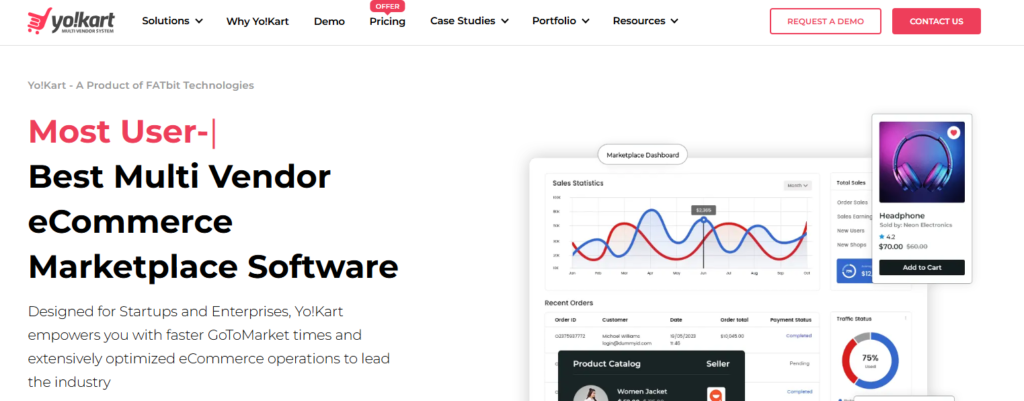
Yo!Kart has been around since 2015 and has powered more than 5,500 ecommerce businesses across 70+ countries. It’s a self-hosted, license-based solution, so once you pay, you own the software outright — no recurring SaaS bill.
- Dedicated panels for admin, sellers, customers, affiliates, and advertisers
- Native mobile apps for both iOS and Android out of the box
- Supports multiple currencies and a responsive design across all devices
Trade-off: it’s not WordPress-native, so if your team already lives in WordPress, you’re learning a new stack.
3. Mirakl — Best for Enterprise-Scale Marketplaces

Mirakl is built exclusively for large retailers running complex vendor ecosystems. It’s a fully managed, AI-powered enterprise solution with deep integrations, advanced automation, and fraud detection, using a modern MACH architecture for high performance and scalable, mobile-first deployment.
- Deep automation — AI-driven vendor onboarding, catalog management, and order routing at enterprise volume
- Fraud detection — built-in risk scoring and monitoring across large vendor networks
- MACH architecture — microservices-based, API-first, cloud-native, headless design for high-performance, mobile-first deployment
- Enterprise integrations — connects with existing ERP, PIM, and CRM systems already in use at large organizations
Trade-off: it’s the most expensive and complex platform in its class — overkill unless you’re already operating at a serious scale.
4. CS-Cart Multi-Vendor & Arcadier — Solid Mid-Tier Alternatives

CS-Cart remains a popular open-source pick for merchants who want a customizable storefront without an enterprise price tag. Arcadier, meanwhile, is a SaaS option offering customizable storefronts, multi-currency and multi-language support, automated shipping and tax calculation, and integration with major payment gateways, with pricing starting at $99 a month after a 14-day free trial.
- Vendor storefront customization — each seller gets a themeable, brandable storefront within the marketplace
- One-time license — no recurring SaaS fee, similar ownership model to Yo!Kart
- Built-in marketplace themes — pre-designed storefront templates to speed up launch
- Open-source flexibility — access to the codebase for teams wanting deep custom development
Trade-off: not WordPress-native, so teams already invested in the WordPress ecosystem face a separate learning curve and hosting setup.
5. Sharetribe — Best No-Code Option for Fast Marketplace MVPs

Sharetribe is built for founders who want to test a marketplace idea without writing code or hiring a dev team. It’s a hosted SaaS platform, so setup happens through a visual builder rather than server configuration.
- No-code marketplace builder — launch a working storefront in days, not months, using pre-built templates for service, rental, and product marketplaces
- Flexible transaction models — supports booking-based, product-based, and service-based marketplaces out of the box
- Built-in payments and messaging — Stripe-powered payouts and in-app buyer-seller messaging without extra plugins
- Custom branding — themeable storefront design without touching code, though deeper customization needs their dev-friendly “Sharetribe Flex” tier
Trade-off: it’s SaaS-hosted, so you’re renting your marketplace rather than owning it outright, and monthly subscription costs scale with usage. Deep customization beyond the no-code layer requires developer resources.
6. Arcadier — Best SaaS Simplicity for SMBs

Arcadier targets small and mid-size businesses that want marketplace software without the overhead of managing infrastructure. It’s a fully hosted SaaS solution with a straightforward setup path.
- 14-day free trial — test the platform before committing, with plans starting from $99/month
- Customizable storefronts — adjust branding and layout without needing a dev team
- Multi-currency and multi-language support — built in for marketplaces serving international buyers and vendors
- Automated shipping and tax calculation — reduces manual overhead as order volume grows
- Native payment gateway integrations — connects with major providers without custom API work
Trade-off: as a SaaS product, you don’t own the underlying platform, and costs rise as your marketplace scales in transaction volume or feature needs.
StoreEngine vs. The Competition: A Closer Look
| Feature | StoreEngine | Typical WooCommerce Multi-Vendor Stack | SaaS Marketplace (e.g. Mirakl, Arcadier) |
| Setup complexity | One plugin, guided setup | Multiple plugins to install & maintain | Vendor-managed, faster but less control |
| Ongoing plugin conflicts | Minimal — unified codebase | Common — separate vendors, separate updates | Not applicable |
| Recurring cost | One license, no forced add-ons | License + add-ons + subscriptions add up | Monthly/GMV-based fees |
| Data ownership | Full — self-hosted | Full — self-hosted | Limited — hosted by vendor |
| Built-in affiliate system | Yes | Usually a separate plugin | Varies by provider |
| Tax automation | Yes, location-based | Add-on dependent | Usually included |
How to Choose the Right Platform for Your Business
- If you’re on WordPress and want everything in one plugin: go with StoreEngine.
- If you want a one-time license and don’t mind a dedicated platform outside WordPress: Yo!Kart is a strong pick.
- If you’re a large enterprise replatforming a complex vendor network: Mirakl earns its price tag.
- If you want a no-code MVP to validate an idea fast: look at Sharetribe or Arcadier.
Frequently Asked Questions
What is the best multi-vendor ecommerce platform for WordPress? StoreEngine is the strongest WordPress-native option in 2026 because it bundles multi-vendor selling, payments, subscriptions, and affiliate management into a single plugin instead of forcing you to stack separate add-ons.
How much does it cost to build a multi-vendor marketplace? Costs range from a few hundred dollars for a WordPress-based license like StoreEngine to enterprise SaaS contracts running into six figures for platforms like Mirakl. Your real cost driver is usually ongoing add-ons and transaction fees, not the sticker price.
Can I turn an existing WooCommerce store into a marketplace? Yes, though the usual approach means bolting a multi-vendor extension onto your existing setup. StoreEngine avoids this by including multi-vendor functionality natively, so you’re not managing a second plugin’s update cycle.
Is a multi-vendor marketplace profitable in 2026? It can be. Revenue comes from vendor commissions, subscription fees, featured listings, and advertising — common models include charging 5–15% commission per order or monthly vendor membership plans for premium features. Profitability depends more on vendor supply and buyer trust than on the software itself.
What’s the biggest challenge in running a multi-vendor marketplace? Vendor quality control, building initial customer trust, logistics and delivery, resolving disputes, and platform security tend to be the recurring pain points, regardless of which platform you choose.
Final Verdict
There’s no universal “best” platform — only the best fit for where you’re starting from. But if you’re building on WordPress and want to launch a multi-vendor marketplace without becoming a part-time plugin-conflict technician, StoreEngine is the platform to beat in 2026. It folds payments, multi-vendor selling, subscriptions, affiliates, and tax handling into one lightweight plugin, which means less time debugging and more time signing up vendors.
“Behind the scenes, your hosting infrastructure plays a crucial role. Multi-vendor platforms with heavy database queries benefit immensely from LiteSpeed servers, which handle concurrent vendor and customer traffic without slowing down. Pairing your chosen platform with optimized hosting isn’t optional-it’s essential for scaling.”
Ready to see it in action? Build your store with StoreEngine and get your first vendor onboarded today.